Cybersecurity in Practice: Breaking Down the Career Paths
Most product engineering teams are doing security work. They patch servers, chase audit findings, and fix CVEs. They rarely call any of it cybersecurity.
Cybersecurity Career Paths Start With What You Already Do
Running an engineering org at a product company means dealing with security constantly, just not always under that label. We monitor and remediate vulnerabilities in OS packages, Docker base images, and third-party libraries. We manage PCI DSS compliance: scoping the cardholder data environment, coordinating with a Qualified Security Assessor, and working through remediation items before each audit cycle. We satisfy SOX IT general controls: change management processes, access provisioning and deprovisioning, audit logging, and separation of duties. We handle security findings that come from internal reviews and external researchers. When I wrote it down as a list, I realized the security work was already substantial. It just lacked a frame. Understanding the cybersecurity career paths is part of building that frame.
Why Security Means More When You Handle Real Money
The stakes of getting security wrong are different when your product processes payments. Our platform handles international calls, mobile top-ups, and digital remittances. Customers are emigrants sending money home, often to family with no other reliable option. That puts us inside PCI DSS scope for cardholder data and inside SOX scope for financial reporting controls. A breach is not just a reputational event. It carries regulatory consequences, potential customer harm, and legal exposure. Compliance requirements like PCI DSS and SOX are often framed as bureaucratic overhead. From inside a product company that processes real transactions, they read differently. They are the floor, not the ceiling. The actual security work is everything that sits above the audit checklist.
The Main Cybersecurity Career Paths: AppSec, GRC, Blue Team, Red Team
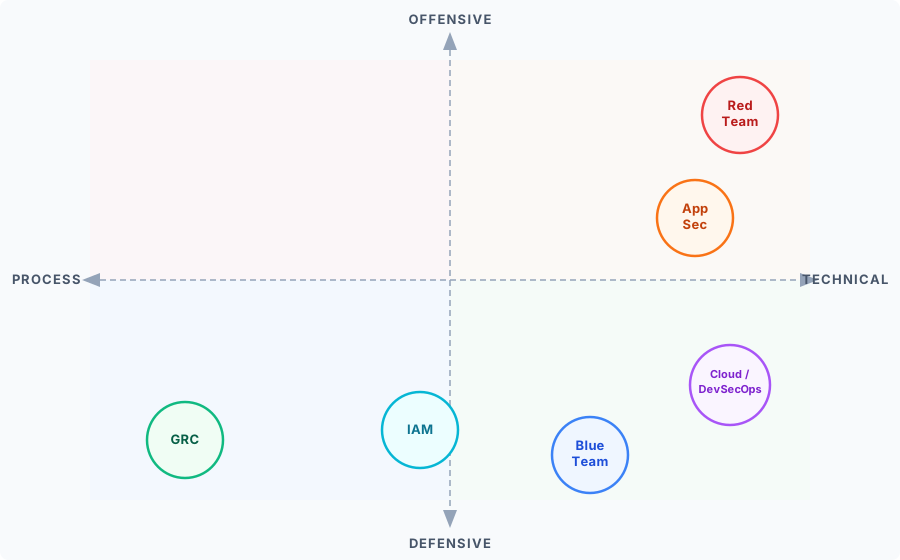
Cybersecurity is not one field. It is several disciplines that share a threat model but operate in different ways, require different skills, and offer different career trajectories.
Application Security (AppSec) focuses on securing the software itself. Code review, static and dynamic analysis (SAST/DAST), threat modeling, dependency scanning, and embedding security checkpoints into the development lifecycle. AppSec engineers work closest to the code and often bridge security teams and product developers.
Governance, Risk, and Compliance (GRC) is where audits and policy live. PCI DSS, SOX, ISO 27001, SOC 2 — this is GRC territory. The work involves risk assessments, control documentation, audit management, and policy writing. It is less hands-on technically and more process and organizational in nature.
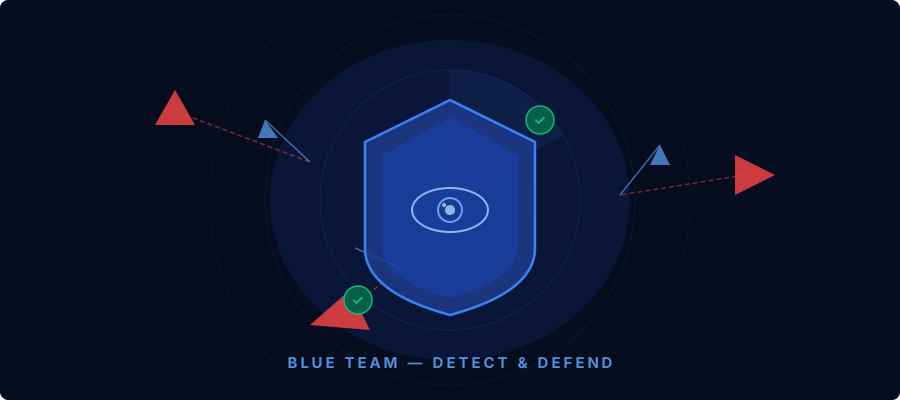
Blue Team / Defensive Security runs the detection and response side. Security operations centers (SOC), SIEM platforms, threat detection rules, incident response playbooks. Blue team engineers build and maintain the systems that catch attackers already inside the environment.
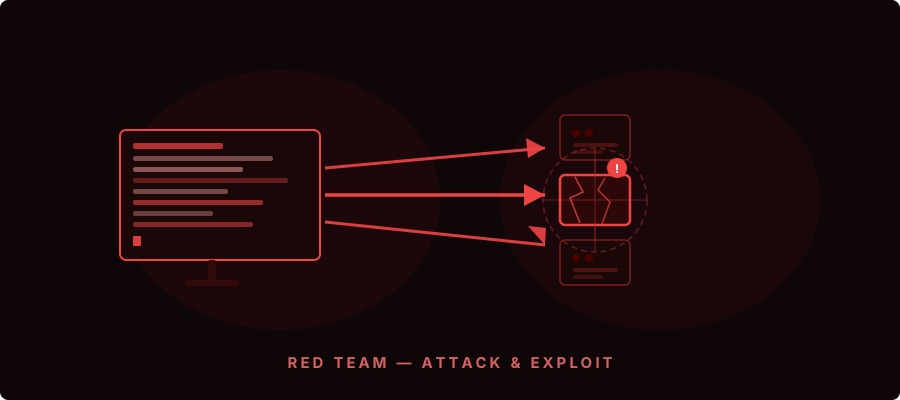
Red Team / Offensive Security is the attack simulation side. Penetration testers and red teamers actively exploit vulnerabilities to find what defenders miss. This path typically requires the deepest technical knowledge of how systems break.
Cloud Security and DevSecOps sits at the intersection of platform engineering and security. Container hardening, IAM policy, secrets management, network segmentation, and shifting security left into CI/CD pipelines. For engineering teams running on cloud infrastructure, this path is increasingly hard to separate from regular platform work.
Identity and Access Management (IAM) is a specialty in its own right: authentication protocols, authorization models, SSO, zero trust architecture, and managing access at scale. IAM failures are behind a significant percentage of real-world breaches, which makes it both critical and underappreciated as a career path.
Each of these paths has different entry requirements, different certification tracks, and different day-to-day work. GRC and red teaming are both “cybersecurity” in title while having almost nothing in common in practice.
Where This Series Goes
- Vulnerability management across engineering teams
- OS and container patching
- PCI DSS remediation from the inside
- SOX IT general controls for engineering teams
- Threat modeling in practice
- Building security culture without a dedicated security team
- CompTIA Security+: what it covers and what it doesn’t
Enjoy Reading This Article?
Here are some more articles you might like to read next: